


How to make squirrel traps – The various forms and schemes for home-made traps that have been devised, and which are to be found in use by boys all over the country, are countless, but there are of course a number of these which are more effective than others, and some which have gained more favor among boys.
Excerpt from the book THE BOY CRAFTSMAN – Practical and Profitable Ideas for a Boy’s Leisure Hours BY A. Neely Hall – With more than four hundred illustrations by the author and Norman P. Hall Published, August, 1905.
- – – –
Several years ago the author wrote an article upon traps, and has since been more than pleased to note the success boys have had in making and using them. With a few additions, the same schemes have been embodied in this chapter, and it is hoped that the several kinds of snares and traps will prove as satisfying to the majority of boy trappers.

They are all simple to make, require but the material ordinarily at hand, and are effective for most of the smaller species of animals, and many varieties of birds.
One of the oldest forms of traps, and one of which every boy should understand the construction, is The Figure-four Trap.
It is about the simplest example, and its principle will be found in the schemes of a great many of the more complicated traps. For this the preparation of three sticks, such as are shown in Fig. 214, will be necessary.

Fig. 214.—Stick for the Figure-four Trap.
These sticks may be made of any length you wish, but their proportion should be about as shown in the drawings. The illustrations show clearly how the sticks should be notched, and how one end of the trigger should be tapered for the bait.
Fig. 215 will explain the manner in which these sticks are placed together in the form of a figure-four.

Fig. 215.—The Figure-four.
The rest of the trap consists of a soap-or cracker-box with the cover hinged to it.
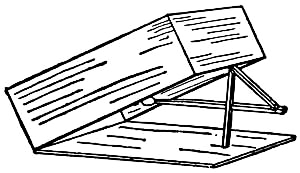
Fig. 216.—The Figure-four Trap set.
To set the trap, place the box upon the ground, cover down, and rest its upper edge upon the top of the figure-four, as shown in Fig. 216. When putting the figure-four together, it is necessary to hold the sticks until the box is set upon them, as the weight is required to hold them in position.
For squirrels and rabbits, for which this trap is very good, bait the trigger with a carrot, piece of apple, or cabbage leaf. It is easy to see that the slightest nibble at the bait will disarrange the sticks, and cause the box to drop over the game.

Figs. 217-219.—A Box Trap.
Read more…
Best way to catch a squirrel in attic …
Humane Live-Capture and Release of Squirrels: Safety, Legal, and Animal Welfare Considerations
Before You Capture Any Wildlife
Check local laws and regulations before attempting to capture, relocate, or release wild squirrels. In many areas, wildlife relocation is restricted or requires permits because moving animals can spread disease, disrupt ecosystems, or reduce the animal’s chances of survival.
Determine Whether Capture Is Necessary
Live capture should generally be considered only when:
- A squirrel is causing significant property damage, such as chewing wiring, entering attics, or damaging structures.
- An animal is trapped in a hazardous location.
- A wildlife professional has recommended intervention.
For occasional backyard visitors, non-capture methods such as exclusion, habitat modification, or deterrents are often more effective and less stressful for wildlife.
Choose a Humane Capture Method
A humane live-capture system should:
- Avoid causing injury, entanglement, or prolonged restraint.
- Protect the animal from extreme temperatures, rain, and direct sunlight.
- Provide adequate ventilation.
- Prevent escape without causing panic or self-injury.
Avoid devices that can injure feet, legs, teeth, tails, or fur.
Minimize Stress During Capture
Wild squirrels are highly sensitive to stress and can become frightened quickly.
To reduce stress:
- Check traps frequently.
- Avoid excessive handling.
- Keep noise and activity around the trap to a minimum.
- Cover the trap with a light cloth once an animal is captured to help calm it.
- Keep children and pets away.
Monitor Frequently
A trapped squirrel should never be left unattended for extended periods.
Frequent monitoring helps prevent:
- Heat stress
- Dehydration
- Exposure to severe weather
- Predation by dogs, cats, hawks, owls, or other predators
- Panic-related injuries
Safe Handling Practices
If handling becomes necessary:
- Wear gloves to protect both yourself and the animal.
- Lift carriers securely from the bottom.
- Keep fingers away from the wire mesh and openings.
- Move slowly and calmly to avoid startling the animal.
A frightened squirrel may bite or scratch in self-defense if it feels threatened.
Release Considerations
When release is legally permitted:
- Release the animal as soon as practical.
- Choose a safe area with natural cover and suitable habitat.
- Avoid releasing near roads, busy trails, or areas with heavy predator activity.
- Open the carrier and allow the squirrel to leave on its own rather than forcing it out.
Be aware that relocating squirrels far from their home territory may reduce their chances of survival and can be prohibited in some jurisdictions.
When to Contact a Wildlife Professional
Seek assistance if:
- The squirrel appears injured.
- The animal is unusually lethargic, disoriented, or weak.
- Young squirrels are present and may be dependent on a nearby mother.
- Local regulations prohibit relocation.
- You are unsure how to safely handle or release the animal.
Long-Term Prevention
After release, address the reason the squirrel was attracted to the area:
- Seal openings into attics, sheds, and crawl spaces.
- Trim tree branches that provide roof access.
- Protect vulnerable wiring and building materials.
- Secure bird feeders and food sources where appropriate.
- Remove access to nesting sites and use wildlife-friendly exclusion methods.
Key Principle
The most humane wildlife management approach is prevention first, capture only when necessary, and minimizing stress, injury, and confinement time whenever an animal must be handled. Responsible coexistence and effective exclusion measures are often more successful than repeated capture and relocation.


